P0420 Keeps Coming Back? Here's Why You're Fixing the Wrong Thing
P0420 Keeps Coming Back? Here's Why You're Fixing the Wrong Thing
If you've cleared P0420 more than once and watched it crawl back onto your dashboard like it never left, you're not alone. This code might be the single most mishandled trouble code in DIY repair — not because it's complicated, but because the path of least resistance (replace the cat, call it a day) is also the path most likely to leave you right back where you started.
Let's slow down and actually work through this one.
What P0420 Is Actually Saying
The full definition reads something like "Catalyst System Efficiency Below Threshold, Bank 1." Your engine control module (ECM) monitors the catalytic converter's performance by comparing activity between the upstream and downstream oxygen sensors. A healthy cat scrubs exhaust gases so efficiently that the downstream O2 sensor should show relatively flat, stable voltage — it's not seeing much left to react to. When that sensor starts mimicking the upstream sensor's switching pattern, the ECM flags it as evidence the converter isn't doing its job.
That's the theory. The reality is messier.
The code tells you the system detected low efficiency. It does not confirm the catalytic converter is dead. That's a critical distinction, and skipping past it is exactly how people end up buying a $700 aftermarket cat that doesn't fix anything.
The Three Usual Suspects (And Only One Is the Converter)
Before you even look up converter prices, run through this list. Each of these can generate a legitimate P0420 without the catalytic converter being the root problem.
1. A Failing Upstream O2 Sensor
If your upstream (pre-cat) oxygen sensor is lazy, sluggish, or just reading slightly off, it can distort the efficiency calculation. The ECM is essentially running a comparison — bad input data on one side skews the whole result. A sensor that's slow to respond looks, to the ECM, like a converter that isn't converting. The fix here is a $30–$80 sensor, not an $800 cat.
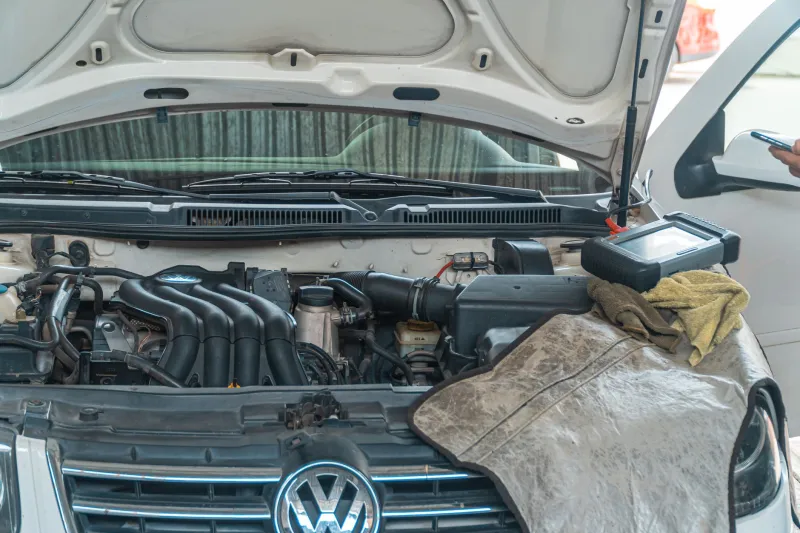
How do you tell? Pull live data on both sensors using a scan tool that shows O2 sensor waveforms. The upstream sensor should be switching actively (roughly 0.1V to 0.9V, multiple times per second at cruising speed). The downstream should be relatively stable. If your upstream sensor looks sluggish or flat, start there.
2. Exhaust Leaks Upstream of the Sensor
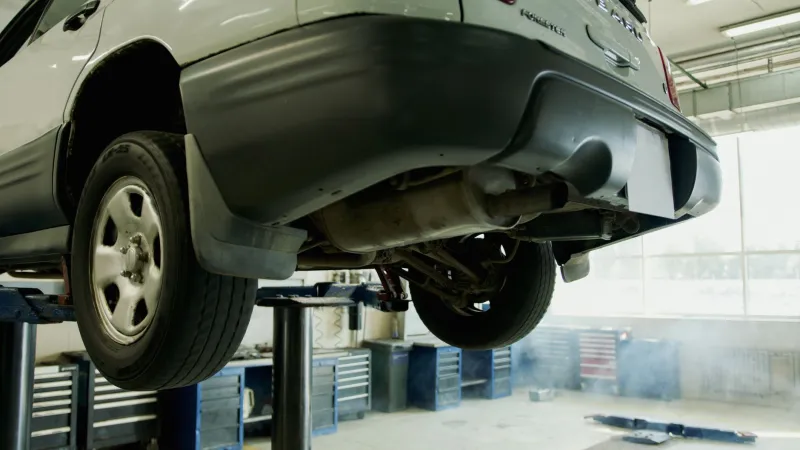
A small exhaust leak between the engine and the catalytic converter introduces outside oxygen into the exhaust stream. That extra oxygen throws off the downstream O2 sensor's readings, making the ECM think the converter is underperforming. You might hear a faint ticking or hissing sound at idle, especially when the engine is cold. Run your hand carefully near manifold gaskets and flex pipes while the engine is running — you might feel a pulse of hot air. A smoke test on the exhaust side can also locate leaks you can't find by ear.
Fix the leak first. Then clear the code and drive it. You might be done.
3. Engine Misfires — Even Subtle Ones
This one surprises people. An engine misfire sends unburned fuel into the exhaust, and that fuel can actually overheat and damage the catalytic converter over time. But even before permanent damage happens, a misfire can cause temporary converter inefficiency that sets P0420. If you have any pending misfire codes — P030X codes for individual cylinders — address those before touching the cat. Running a misfire diagnosis is free with any basic scanner. Running a misfire diagnosis and ignoring it costs you a catalytic converter.
Check your spark plugs, ignition coils, and fuel injectors if misfires are present. A worn plug on cylinder 1 shouldn't cost you $800.
So When Is the Converter Actually Bad?
Fair question. Catalytic converters do fail, especially on higher-mileage vehicles. Here's what genuine converter failure tends to look like:
- The code returns quickly after clearing — within 50 to 100 drive miles — even after ruling out sensors, leaks, and misfires.
- Live O2 data shows the downstream sensor actively switching in a pattern that mirrors the upstream sensor, indicating the cat isn't processing gases at all.
- A backpressure test shows elevated restriction — this requires a pressure gauge tapped into the O2 sensor port upstream of the converter. High backpressure (generally above 1.5–2 PSI at idle, though specs vary) can indicate a collapsed or clogged substrate inside the converter.
- Physical inspection reveals damage — rattling from inside the converter, a strong sulfur smell, or visible damage to the housing.
If you've genuinely ruled everything else out and the data points to the converter, then yes, replace it. But make sure you're using a quality replacement. In many states, emissions regulations require a CARB-compliant converter, and using a non-compliant unit can actually cause the code to return even with a brand-new part. Check your state's requirements before ordering.
Why Shops Get This Wrong (And How to Push Back)
Here's an uncomfortable truth: P0420 is sometimes treated as a revenue opportunity rather than a diagnostic challenge. The code sounds like "bad catalytic converter" to anyone who doesn't dig deeper, and converters are expensive repairs with decent shop margins. That's not to say every shop is cutting corners — many aren't — but if a technician recommends a catalytic converter replacement without showing you O2 sensor waveform data, a misfire check, and an exhaust leak inspection first, it's completely reasonable to ask for that documentation.
A legitimate diagnostic workflow for P0420 looks like this:
- Pull all stored and pending codes — misfires, O2 sensor codes, fuel trim codes
- Inspect for exhaust leaks, especially near manifold gaskets and flex pipes
- Review live O2 sensor data on both upstream and downstream sensors
- Check fuel trims — large positive long-term fuel trims suggest a lean condition that can affect converter efficiency
- Perform a backpressure test if other steps don't reveal the issue
- Only after ruling out all of the above: evaluate converter replacement
If a shop skips steps 1 through 5 and goes straight to step 6, that's a red flag worth addressing.
Clearing the Code Isn't a Fix — It's a Countdown
Every time you clear P0420 without addressing the underlying cause, you're essentially resetting a timer. The code will come back. And if there's an active misfire or a lean condition feeding the issue, you may be actively shortening the life of a converter that was still functional when this started.
The goal here isn't just to get the light off. The goal is to understand what the car is actually telling you, work through it methodically, and fix the right thing the first time. That's the difference between a $40 O2 sensor and an unnecessary $900 repair.
Your scanner gave you a starting point. Don't let it be the ending point, too.