When Fixing One Code Breaks Your Budget: How Mechanics Fall Into the Domino Trap

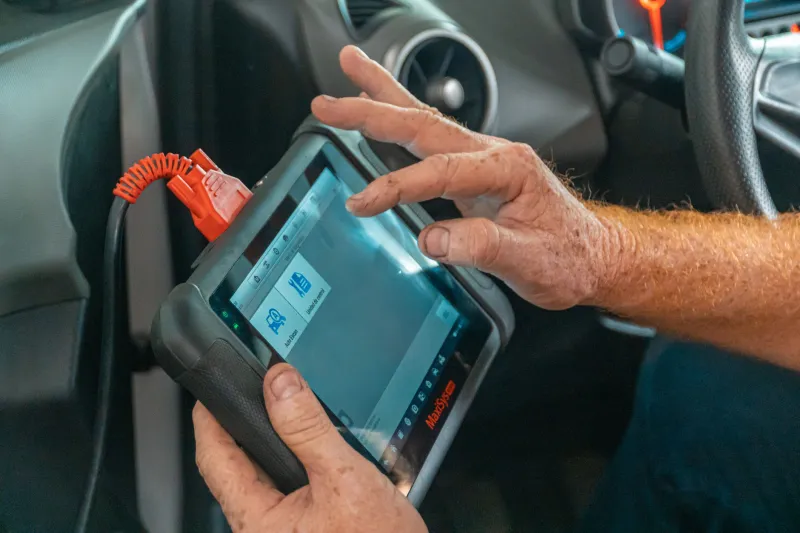
You drop your car off with a check engine light. The tech plugs in a scanner, pulls four codes, and starts building an estimate. By the time you get the call, you're looking at $900 in parts and labor — and a promise that everything will be sorted by Friday.
Friday comes. Two of the four codes are back.
This isn't a horror story unique to shady shops. It happens at dealerships, independent garages, and everywhere in between. The reason isn't always incompetence. Sometimes it's a diagnostic trap that's embarrassingly easy to fall into: treating every code as its own separate problem instead of asking which one started the chain reaction.
Why Multiple Codes Almost Never Mean Multiple Problems
Here's something your scanner won't tell you: when several fault codes appear at the same time, there's a strong chance they share a single origin. Modern vehicles are deeply interconnected — sensors feed data to modules, modules talk to each other, and one bad reading upstream can cascade into three or four error codes downstream before you've even noticed the check engine light.
Mechanics call these secondary codes or cascade faults, and they're one of the most common sources of misdiagnosis in the industry. If a shop doesn't stop to ask "which of these codes could logically cause the others," they'll often start replacing parts in alphabetical order and bill you for every single one.
A failing crankshaft position sensor, for example, can trigger misfires across multiple cylinders, an ignition timing fault, and even a fuel trim code — all at once. If a tech sees P0301, P0302, P0303, and P0340 on the same screen and starts ordering coil packs and injectors without reading P0340 first, they've already gone off the rails.
Real Shops, Real Money Lost
Consider what happened to a driver in suburban Atlanta who brought in a 2014 Ford F-150 with a rough idle and four active codes. The shop replaced two oxygen sensors and a mass airflow sensor — nearly $700 in parts alone. The rough idle didn't improve. The codes came back within 48 hours.
A second shop looked at the same codes, noticed a small vacuum leak at the intake manifold gasket, fixed it for $180, and watched all four codes disappear in a single test drive. The first shop hadn't been lazy — they'd been undisciplined. They saw multiple codes and assumed multiple failures. They never asked which fault could logically produce all the others.
Or take the case of a 2017 Chevy Equinox that showed up at an independent shop in Denver with what looked like an EVAP system nightmare: three separate EVAP codes alongside a fuel pressure code. The shop started recommending a purge valve, a vent solenoid, and a fuel pump. Total estimate: $1,100.
The actual problem? A cracked fuel cap seal. Twelve dollars. Once it was replaced and the system was retested under proper conditions, every code cleared and stayed gone.
The Diagnostic Discipline That Changes Everything
So what separates a thorough shop from a code-spray-and-pray operation? It comes down to a few habits that disciplined technicians follow every single time.
They prioritize codes by system hierarchy. Not all codes are created equal. Codes related to fundamental engine management — crankshaft position, camshaft timing, fuel pressure — should always be investigated before secondary codes like misfires or trim faults. A tech who starts with the trim fault is working backward.
They clear codes and retest before replacing anything. Clearing the codes and doing a structured test drive tells you which codes return first and under what conditions. That sequence is often more valuable than the codes themselves. The code that comes back first is usually the root cause.
They use freeze frame data to establish timeline. Freeze frame captures the engine conditions at the exact moment a fault was logged. If the freeze frame on a misfire code shows normal fuel trims and a normal crankshaft signal, the misfire probably isn't caused by an ignition fault. If it shows a wild crankshaft reading, start there.
They ask: could Code A cause Code B? This sounds simple, but it's the question that gets skipped most often under time pressure. A shop running six bays with a full schedule doesn't always have a tech who stops to map out the logical relationship between faults before writing an estimate.
What You Can Do Before You Hand Over the Keys
You don't need to be a mechanic to protect yourself here. A few simple moves can make a big difference.
When a shop pulls multiple codes, ask them directly: "Are any of these codes likely related to each other? Which one do you think came first?" A good tech will have an answer. A shop running on autopilot will give you a blank stare or pivot immediately to the estimate.
If you have your own OBD-II scanner, pull the codes yourself before you go in. Write down all the codes and the order they appear. Some budget scanners will also show you pending codes — faults that haven't fully triggered yet — which can reveal patterns the shop might miss if they're only looking at confirmed codes.
Ask whether the shop plans to clear codes and retest before replacing parts. If the answer is no — if they're quoting parts based purely on what's currently stored — that's a yellow flag.
The Bottom Line
Multiple codes on a scanner readout aren't a shopping list. They're a symptom map, and reading them correctly requires following the logic of how your car's systems interact rather than treating each code as its own isolated problem.
The shops that get this right aren't necessarily smarter — they're just more disciplined. They slow down, ask better questions, and resist the temptation to start replacing parts before they understand what actually failed first.
When you're the one paying the bill, that discipline is worth asking about up front.