Dealer Tool vs. Aftermarket Scanner: What You're Actually Paying For — and When It Matters
You've probably heard the pitch before: bring your car to the dealer for a "full diagnostic" because only they have the right tools. It sounds like a sales tactic — and sometimes it is. But sometimes it's completely true, and knowing the difference can save you from either overpaying at a dealership or under-diagnosing at an independent shop.
The gap between what a consumer-grade OBD-II scanner sees and what a factory diagnostic system sees is real, and it's wider than most drivers realize. Understanding where that gap lives — and where it doesn't — is one of the more practical things you can learn as a car owner.
What Every Scanner Can See (and What That Covers)
The OBD-II standard, which became mandatory on all US vehicles in 1996, defines a universal set of diagnostic functions that any compliant scanner can access. This includes the standard powertrain codes (P0xxx), emissions-related monitors, freeze frame data, and a core set of live sensor readings.
For a huge percentage of common repairs — oxygen sensor faults, misfires, EVAP leaks, coolant temperature issues, basic fuel system codes — a quality aftermarket scanner gets you everything you need. The $80 handheld unit at AutoZone and the $50,000 factory tool will both pull P0171 (system running lean, bank 1) from the same car and give you essentially the same information.
So if someone tells you that you always need a dealer scan, that's not accurate. For a lot of everyday diagnostic work, it's simply not true.
Where Aftermarket Scanners Hit a Wall
Here's where things get complicated. Beyond the standardized OBD-II layer, every automaker builds a proprietary diagnostic layer into their vehicles — and that layer is not required to be accessible to anyone outside their authorized network.
This proprietary tier covers things like:
- Body control module (BCM) codes — faults in your power windows, door locks, lighting systems, and keyless entry
- Transmission control module (TCM) data — detailed shift adaptation values, solenoid duty cycles, clutch pack pressure readings
- ABS and stability control modules — wheel speed sensor calibration, yaw rate sensor data, actuator tests
- HVAC and infotainment systems — blend door positions, refrigerant pressure sensor readings, module communication errors
- Advanced driver assistance systems (ADAS) — radar calibration status, camera alignment data, sensor fault histories
- Bi-directional controls — the ability to command the car to run specific tests, like cycling an ABS pump or commanding a fuel injector to fire
A $200 Bluetooth dongle might show you a generic code that vaguely points toward your ABS module. A factory tool like GM's GDS2 or Ford's FDRS will show you exactly which wheel speed sensor is drifting, what the signal looks like in real time, and whether the module itself has flagged a communication fault from another module. That's a completely different level of detail.
For a vehicle with an ADAS calibration issue after a windshield replacement, for instance, an aftermarket scanner often can't even see the fault — let alone perform the recalibration procedure. That's a dealer-only job in many cases.
The Middle Ground: Professional Aftermarket Tools
It's worth noting that the diagnostic world isn't just "cheap Bluetooth dongle" versus "dealer tool." Professional-grade aftermarket platforms — Autel, Launch, Snap-on, Bosch — occupy a middle tier that independent shops increasingly rely on.
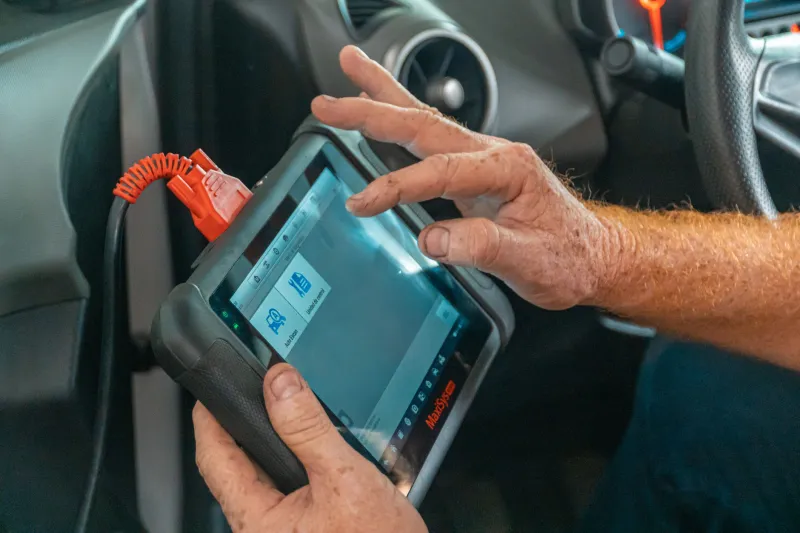
A well-equipped independent shop running a current Autel MaxiSys or a Snap-on Zeus can access manufacturer-specific codes on most makes and models, perform many bi-directional tests, and run module programming on a growing list of vehicles. These systems cost anywhere from $3,000 to $15,000 and require ongoing subscription fees to stay current.
The gap between a professional aftermarket tool and a factory tool has narrowed significantly over the past decade. But it hasn't closed entirely, and it's most noticeable on newer vehicles — particularly those with heavy ADAS content, complex hybrid/EV systems, or proprietary communication protocols that manufacturers guard carefully.
When You Actually Need to Go to the Dealer
For most routine repairs on vehicles more than three or four years old, a well-equipped independent shop is perfectly capable. But there are specific situations where the dealer's factory tool is genuinely the right call:
Module programming and reflashing. If your ECU, TCM, or BCM needs to be reprogrammed or replaced, the factory tool is often required to complete the procedure correctly. Some independent shops can access OEM programming through subscription services like ACDelco TDS or Ford's Motorcraft, but not all of them.
ADAS calibration after collision repair. Cameras, radar sensors, and ultrasonic sensors often need recalibration after even minor front-end work. Factory calibration specs and procedures are typically only fully accessible through OEM tools.
Active recalls and software updates. Dealer tools have direct access to OEM update servers. If your vehicle has an open recall that involves a software fix, the dealer is the only place to get it done correctly.
Warranty work. If the repair falls under your factory warranty or powertrain coverage, you need the dealer anyway — but their diagnostic tool is also what documents the fault in a way that satisfies the warranty claim process.
Newer vehicles with heavy proprietary content. A 2022 or 2023 vehicle with a full suite of driver assistance technology is a different animal than a 2014 pickup. The more recent and technology-heavy the vehicle, the more likely you'll hit aftermarket tool limitations.
Navigating Conflicting Diagnoses
Here's a scenario that's becoming more common: you get a diagnosis from an independent shop, then a different (and more expensive) diagnosis from a dealer, and now you're not sure who to believe or how to proceed.
First, ask both shops to show you the specific codes and data they're working from. If the independent shop is basing their recommendation on a generic OBD-II code and the dealer has proprietary module data that tells a different story, the dealer is likely more accurate — not because they're more honest, but because they have more information.
If both shops are working from the same code and simply disagree on the fix, that's a different conversation — and getting a third opinion from another independent shop with professional-grade tools is worth the cost.
Also ask the independent shop directly: "Do you have the ability to access manufacturer-specific data on this make and model?" A good shop will answer that question honestly and tell you if there's a reason to send you to the dealer for a more complete scan before they proceed.
The Bottom Line
The scanner gap is real, but it's also specific. For a lot of what goes wrong on everyday vehicles, an aftermarket tool — whether yours or a shop's — is more than adequate. The situations where factory diagnostics genuinely matter are narrower than dealers sometimes suggest, but they do exist, and knowing where those boundaries are keeps you from either dismissing the dealer option when you actually need it or paying for it when you don't.