How to Build an Evidence File That Forces Your Mechanic to Take Your Intermittent Problem Seriously

You know the feeling. Your car shudders, hesitates, or throws a warning light during your morning commute — and then behaves perfectly for the three days it sits in the shop parking lot while a tech drives it around the block twice and declares nothing wrong.
Intermittent faults are genuinely one of the most frustrating categories of automotive problems, both for drivers and for honest mechanics. They're not imaginary. They're not the car being moody. They're real failures that only surface under specific conditions — and if you can't recreate those conditions, most shops won't find the cause.
The good news: you can do a lot of the diagnostic legwork yourself. Not with wrenches, but with your phone, a cheap OBD scanner, and a little methodical documentation.
Why Intermittent Problems Are So Hard to Catch
Modern engines and transmissions operate within very tight tolerance ranges. Temperature, humidity, barometric pressure, and load conditions all affect how sensors behave and how modules interpret their signals. A throttle position sensor that reads accurately at 70°F might drift enough at 28°F to confuse the ECU — but only briefly, and only during the first few minutes of operation before everything warms up.
The same logic applies to electrical connections that expand and contract with temperature cycles, fuel pressure regulators that behave differently under high heat soak, and transmission solenoids that stick when cold hydraulic fluid hasn't circulated yet.
Here's the critical piece: many of these faults don't store a code. Or they store a pending code that clears itself before the car reaches the shop. The mechanic plugs in the scanner, sees nothing, and genuinely can't find a starting point. That's not always negligence — it's the nature of the problem.
Your job is to give them a starting point they can actually use.
Step One: Log the Conditions Every Single Time It Happens
Start a note on your phone — or a cheap paper notepad in the glovebox — and record the following every time the symptom appears:
- Date and time
- Outside temperature (check your weather app immediately)
- How long the car had been sitting before you started it
- How long you'd been driving when the symptom occurred
- What you were doing — accelerating hard, cruising at highway speed, idling at a light, climbing a hill
- Humidity or recent weather — had it rained? Was it unusually muggy?
- Whether the AC or heat was running
After three or four occurrences, patterns almost always emerge. Maybe it only happens on mornings below 40°F. Maybe it only appears after 20 minutes of highway driving when you come to a stop. That pattern is diagnostic gold.
Step Two: Use Your Phone to Capture It Happening
This sounds obvious, but most drivers don't do it. Mount your phone on the dash and record video when conditions are right for the symptom to appear. You don't need perfect footage — shaky, dashboard-lit phone video of a shudder, a warning light flickering, or an audible knock is far more convincing to a mechanic than your verbal description.
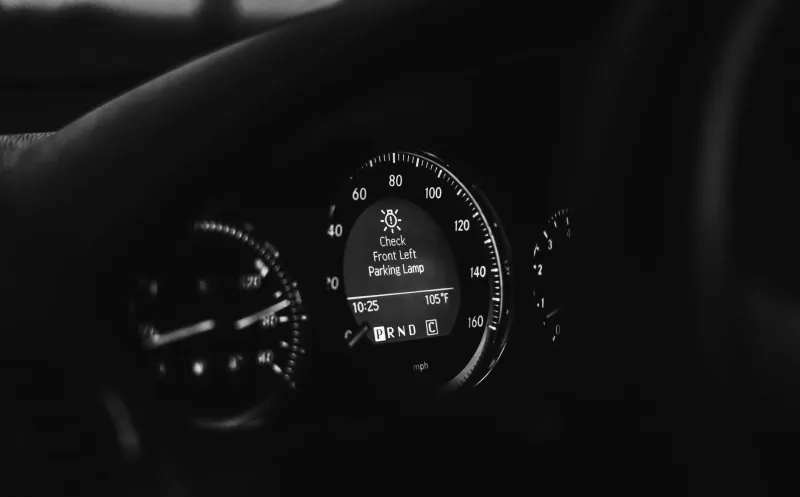
If a warning light appears, photograph the dashboard immediately. Note whether it's solid or flashing — that distinction matters for codes like P0300 (random misfire), where a flashing light indicates an active, potentially damaging misfire rather than a stored historical one.
Step Three: Get a Scanner That Logs Live Data
This is where a $30 Bluetooth OBD-II dongle paired with a free app like Torque or Car Scanner actually earns its keep. These apps can record live data streams — fuel trims, coolant temp, throttle position, O2 sensor voltage, RPM — in the background while you drive.
Set the app to log data continuously on the mornings or routes where your problem tends to appear. When the symptom happens, note the exact time. Later, you can pull up the log and look at what every sensor was doing at that moment. A short-term fuel trim spiking to +25% right when you felt the hesitation is a concrete data point — something a mechanic can actually investigate.
Some apps let you flag moments in the log with a single tap while driving. Learn that feature before you need it.
Step Four: Understand Why Some Codes Require Specific Drive Cycles to Appear
Your car's ECU doesn't log a fault the first time a sensor reads outside its expected range. It typically requires the reading to repeat across a defined number of drive cycles — sometimes called a trip in OBD-II language — before it stores a confirmed code. This is by design, to avoid false alarms from brief sensor noise.
For EVAP system codes, the ECU might only run its leak detection routine under very specific conditions: engine fully warmed up, fuel tank between 15% and 85% full, vehicle speed within a certain range, and altitude below a certain threshold. If your car never meets all those criteria during a shop test drive, the EVAP monitor never runs and the code never appears.
Knowing this lets you tell your mechanic something useful: "The code only appears after a highway drive followed by a cold soak overnight." That's not a hunch — that's a drive cycle description they can try to replicate.
Step Five: Present Your Evidence Like a Case File
When you bring the car in, don't just say "it acts up sometimes." Hand over your notes. Show the video. Pull up the data log on your phone and walk the service advisor through it. Mention the pattern you've identified — the temperature, the conditions, the timing.
A good technician will take that information and use it to either replicate the fault or at least narrow down which system to monitor. A shop that dismisses documented evidence is telling you something important about how they approach diagnosis.
Also ask whether they can keep the car overnight or drive it during the specific conditions where the fault appears. Some shops will do this at no extra charge if you explain the situation clearly. Others will charge a diagnostic fee — which, honestly, is fair if they're doing real investigative work rather than just plugging in a scanner.
The 72-Hour Patience Play
If your problem is genuinely temperature or weather-dependent, it may take more than one shop visit to catch it. That's frustrating, but it's also normal. What you're building with your evidence file is a case that gets stronger with every occurrence — so that when the fault finally does appear in a way the shop can capture, they have enough context to trace it to its source instead of starting from zero.
Intermittent problems get fixed every day. The ones that don't get fixed are usually the ones nobody documented well enough to chase down.