Your Engine Already Healed — But Your ECU Didn't Get the Memo
Your Engine Already Healed — But Your ECU Didn't Get the Memo
You did everything right. Swapped out the dirty MAF sensor, replaced the vacuum line that was cracked and hissing, maybe even cleaned up the throttle body while you were in there. The check engine light went out. You called it a win.
Then a week later, the car still stumbles off idle. Fuel economy hasn't budged. There's a hesitation under light acceleration that just won't quit. You start second-guessing yourself — did you miss something? Is there another part going bad?
Maybe not. There's a decent chance your engine control module (ECM) is still running the old playbook — the one it wrote while something was broken — and nobody told it things have changed.
That's the adaptive fuel trim problem, and it's one of the most overlooked resets in DIY diagnostics.
What Adaptive Fuel Trims Actually Are
Your engine doesn't run on a fixed fuel map. It learns. Every time you drive, the ECM monitors oxygen sensor feedback and makes tiny adjustments to the air-fuel mixture to keep combustion clean and efficient. Those adjustments get stored as long-term fuel trims (LTFT) — essentially a running correction factor the computer applies on top of the base fuel table.
Short-term fuel trims (STFT) are the real-time tweaks happening moment to moment. Long-term trims are what the ECM saves after seeing a consistent pattern over time. Think of STFT as your car reacting, and LTFT as your car remembering.
Under normal conditions, this system is a good thing. It accounts for altitude, fuel quality variations, natural wear, and small sensor drift. But when something actually breaks — a vacuum leak, a failing MAF, a clogged injector — the ECM compensates hard. It cranks the long-term fuel trims way up or way down to keep the engine running. Then you fix the root cause, but those learned corrections are still sitting in memory, still being applied to an engine that no longer needs them.
Now your ECM is over-correcting for a problem that doesn't exist anymore. That's when you get the ghost symptoms: rough idle, sluggish throttle response, worse-than-expected gas mileage, and occasionally a new code that doesn't quite make sense.
How to Tell If Stale Trims Are Your Problem
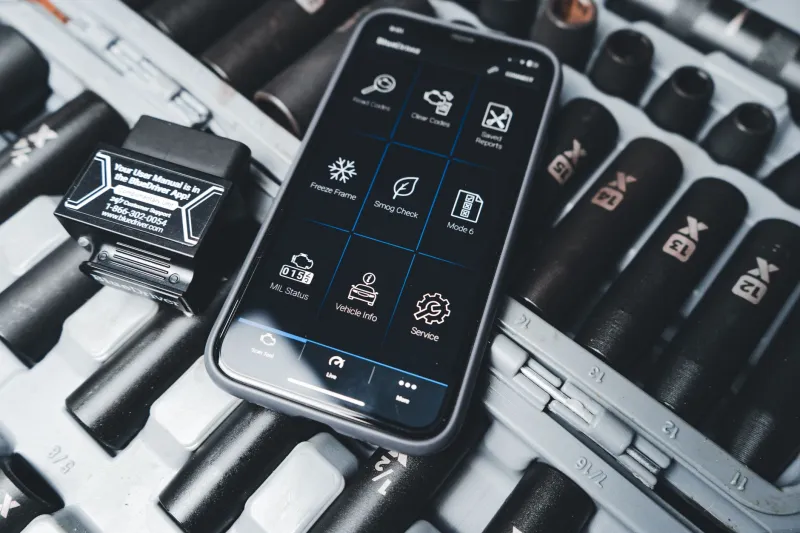
Before you reset anything, take a few minutes with your OBD-II scanner and pull the live fuel trim data. Most mid-range scanners — even some of the $30 Bluetooth dongles paired with a decent app — will show you STFT and LTFT values for each bank.
Here's a rough guide to reading what you see:
- ±5% or less: Normal operating range. Trims are healthy.
- +10% to +25%: The ECM is adding fuel. It thinks the mixture is running lean. Could be a vacuum leak, weak injector, or low fuel pressure — or a corrected problem the ECM hasn't let go of yet.
- -10% to -25%: The ECM is pulling fuel. It thinks the mixture is running rich. Could be a leaky injector, high fuel pressure, or again — a ghost correction from a problem you already fixed.
If your long-term trims are sitting outside that ±5% window after a repair, and your short-term trims are also jumping around trying to compensate, that's a strong signal the ECM is still working off bad learned data.
Cross-reference this with your symptom timeline. Did the rough idle or hesitation show up gradually before you made the repair, and just never fully went away afterward? That pattern fits the stale trim scenario pretty well.
The Reset: What It Is and How to Do It
Resetting adaptive fuel trims clears the long-term learned corrections and forces the ECM to start fresh. It doesn't erase your base tune or your stored codes — it just wipes the accumulated adjustments and puts the learning process back at square one.
There are a few ways to do it:
Method 1 — Disconnect the battery. Old school, but it works on most vehicles. Disconnect the negative terminal and let the car sit for 15–30 minutes. This drains the capacitors and clears volatile memory, including fuel trim data. Reconnect and drive normally. The ECM will re-learn over the next few drive cycles.
Method 2 — Use a scan tool with a reset function. Many mid-level and professional scanners have an "Idle Learn" or "ECM Reset" function buried in the system menu. This is cleaner than a battery disconnect because it preserves your radio presets and doesn't reset your throttle position baseline on vehicles that require a separate relearn.
Method 3 — Pull the ECM fuse. Check your owner's manual or a fuse diagram for your specific vehicle. Pulling the ECM fuse for a few minutes achieves a similar result to the battery disconnect on most platforms, with less disruption to other systems.
After the reset, your car may idle rough or feel slightly off for the first 10–20 minutes of driving. That's normal — the ECM is in active learning mode. Drive a mix of city and highway, let it cycle through idle, light acceleration, and cruise. Most vehicles settle back into a proper tune within one to three complete drive cycles.
When a Reset Is Not the Answer
This is important: a fuel trim reset is a diagnostic step, not a cure-all. If your trims are skewed because there's still an underlying problem — an unresolved vacuum leak, a sensor that's drifting, fuel pressure that's off — the ECM will just re-learn the same bad corrections all over again. You'll be right back where you started within a few days.
The reset is worth trying when:
- You've already made a confirmed repair and symptoms persist
- Fuel trims are significantly out of range with no active codes
- The car ran fine before a specific event (repair, dead battery, fuel system work) and never quite recovered
The reset is not a substitute for diagnosis when:
- You have active codes pointing to a live issue
- Fuel trims are extreme (beyond ±25%) and keep returning after a reset
- You haven't actually identified and corrected a root cause yet
In those cases, the trim data is telling you something real. Don't silence it — use it.
The Bigger Picture
Mechanics aren't hiding this from you out of bad faith — it's just not where most shops start. A reset takes five minutes and costs nothing, which means it usually doesn't come up until after a few hundred dollars of parts have already been swapped. That's not a conspiracy; it's just how the diagnostic funnel tends to work in a shop environment.
But for the DIYer who already made a repair and is still chasing a ghost, this is exactly the kind of zero-dollar step that belongs at the top of the list. Pull your trim data, see what the ECM has been holding onto, and give it a clean slate to work from.
Sometimes the car just needs to forget what it learned — so it can learn something better.